The Summit Was Never Just His: Nimsdai Purja's Legacy Beyond Records
Nirmal "Nimsdai" Purja died in an avalanche on Broad Peak on July 30. What he leaves behind has less to do with speed records than with who gets to hold them.

Just before midday on July 30, an avalanche broke loose on Broad Peak, the 8,051-metre mountain in Pakistan's Karakoram range, killing ten climbers. Among them was Nirmal “Nimsdai” Purja, the Nepali-British mountaineer who had spent much of the previous decade bringing Himalayan climbing to a global audience. The group included five Nepali climbers alongside mountaineers from Oman, the United States, China and Pakistan.
Search teams worked through brutal weather for days. By the weekend, his company, Elite Exped, confirmed what climbers on the mountain had already feared: nobody survived. Purja was 43.To understand why that news travelled from Kathmandu newsrooms to base camps to comment sections that have nothing to do with climbing, you have to understand what Nimsdai actually changed while he was alive.
Nimsdai Purja's Journey From Gurkha Soldier to Mountaineer
He never grew up dreaming about climbing anything. Born in Dana, a village in Nepal's Myagdi district, and raised primarily in Chitwan, Purja came from a family that measured ambition in Gurkha service. His father and three older brothers had all served in the British Army's Gurkha regiments. At 18, he followed them.In 2009, he became the first Gurkha to be selected for Britain's Special Boat Service, where he spent roughly a decade working as a cold-weather warfare specialist. It was not until a period of leave in 2012 that his journey into mountaineering began with what was supposed to be an ordinary trek to Everest Base Camp.
Project Possible Made Nimsdai Purja a Global Mountaineering Icon

In 2018, sixteen years after joining the military, Purja left the SBS, sold his house and set out to do something that sounded made up: climb all fourteen of the world's 8,000-metre peaks in less than seven months. Previously, nobody had done it in less than seven years and ten months. The record belonged to South Korea's Kim Chang-ho, who completed all fourteen in 2013, beating the previous mark set by Poland's Jerzy Kukuczka.
Purja called his attempt Project Possible. Starting with Annapurna in April 2019, he finished in 189 days helped, and later criticised, for his use of bottled oxygen, since Kim's record had been set without it. Purja also broke off his own summit push twice along the way: once to help carry an exhausted Malaysian climber off Annapurna, and once to hand over his oxygen while helping rescue three climbers on Kanchenjunga.
None of it was solo.
Mingma David Sherpa and Gesman Tamang were among those who accompanied him during Project Possible. Yet their names rarely received the attention that followed Purja.
Even his record did not last long. In 2023, Norwegian climber Kristin Harila and her Nepali climbing partner Tenjen Sherpa completed the same fourteen peaks in 92 days.During that 2019 climbing season, Purja also did something that had nothing to do with setting a speed record.
On May 22, while climbing Everest, he photographed an enormous queue of climbers backed up near the top of the world's highest mountain. More than 200 people reached the summit that day during what became one of Everest's deadliest climbing seasons in years. The photograph appeared across international media and became one of the defining images in the debate over overcrowding on Everest, adding to pressure on Nepal over permits, safety and the commercialisation of the mountain.It wasn't a record. It might be the single thing he did that changed the most.

Then came K2.
By the winter of 2021, it was the only one of the world's fourteen 8,000-metre peaks that had never been climbed in winter. It was a challenge considered one of the last major prizes in high-altitude mountaineering. In January 2021, instead of competing against each other for the achievement, Purja and fellow Nepali climber Mingma Gyalje Sherpa brought their efforts together. Thirty feet below the summit, all ten members of the Nepali team stopped. They gathered in a line and walked the final stretch together, singing Nepal's national anthem so that no single climber would be recorded as reaching the summit first.It was, Purja said afterwards, “a message of team unification rather than just me climbing for myself.”
Nimsdai Purja Changed Recognition for Nepali Climbers
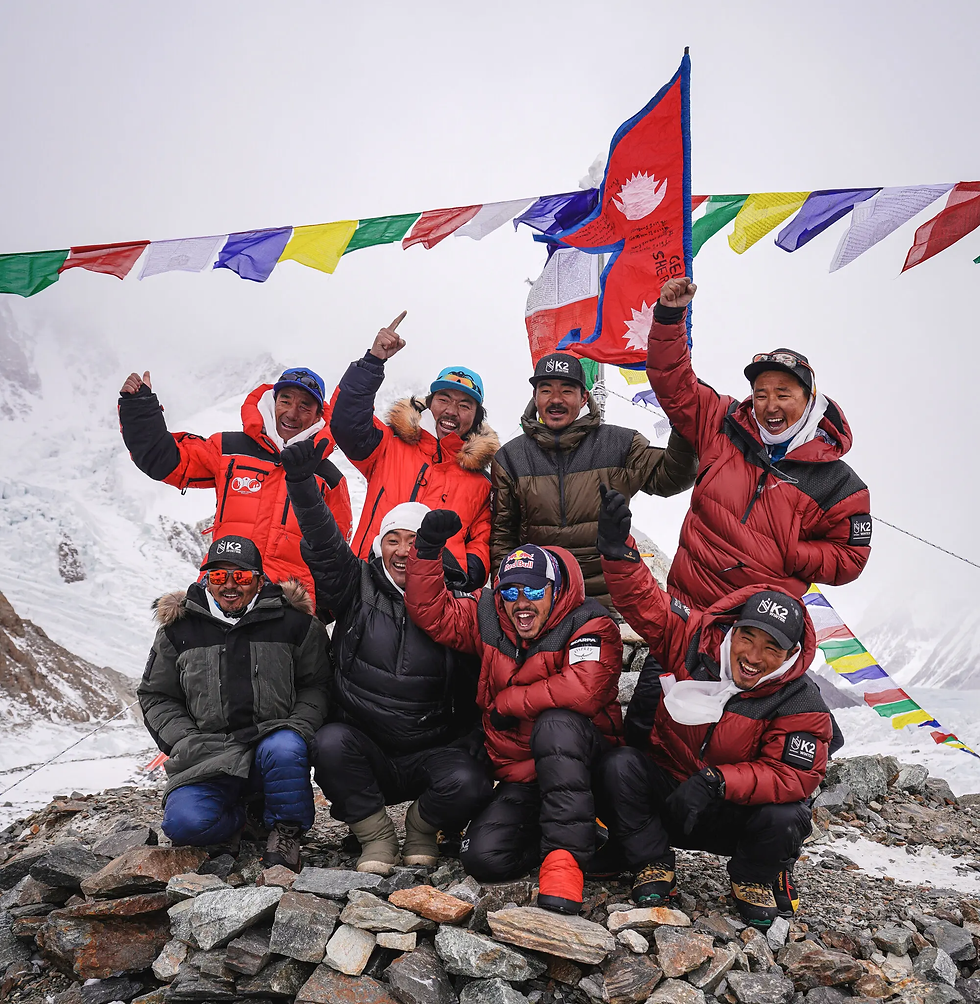
That instinct to make sure credit never collected around one name is the part of his career that outlasts any number. For decades, Nepali and Sherpa climbers had done some of the hardest and least visible work in the Himalayas: fixing ropes, carrying oxygen, establishing camps and opening routes for foreign climbers who often received the magazine profiles afterwards.
Purja refused to stay in that frame.
He regularly named and credited his teammates in his films and social media posts. His Netflix documentary, 14 Peaks: Nothing Is Impossible, then introduced him and his team to an audience far beyond the relatively small world of professional mountaineering. Purja used that attention to make a larger point: Nepali and Sherpa climbers deserved to be seen as elite athletes in their own right, rather than simply as the people helping somebody else reach the summit. “He taught Sherpas not only to climb but to climb for something,” one Everest guide who had worked with him said.
None of this happened because of Purja alone. Nepali-owned expedition companies and internationally recognised Nepali guides were already changing the industry before and alongside him.What Purja added was reach.There was an MBE, a United Nations environmental advocacy role, a foundation involved in clearing waste from Everest and K2, a global documentary and enough public exposure that Nepali mountaineering had a face millions of people outside the climbing world already recognised.
Nimsdai Purja's Legacy Beyond Records and Controversies
That profile came with serious controversies, too.Nepal's tourism authorities investigated his company over an unauthorised helicopter flight and high-altitude training conducted without permission. An oxygen-cylinder explosion in 2022 at a property linked to his company later resulted in a compensation case. In 2024, Purja accused other Sherpa climbers of cutting fixed ropes near Everest's South Summit, triggering a government investigation and anger within parts of the same climbing community he had spent years championing.
That same year, The New York Times reported allegations of sexual harassment and assault from two women, including a client on one of his expeditions. Through his lawyers, Purja denied the allegations and described them as false and defamatory. Those controversies sit alongside his achievements, and any honest account of his public life has to contain both.
His own speed record is already gone, broken by a Norwegian climber and a Nepali one climbing as partners which is, in its own way, exactly the outcome Purja spent his career arguing for. The search operation on Broad Peak was led by Mingma Gyalje Sherpa, the same climber who once stopped thirty feet short of a summit so the credit would belong to everyone.


Comments