The IPL Team That Quietly Built A Cricket Empire

Shah Rukh Khan's Knight Riders Group owns franchises in India, Trinidad, Abu Dhabi and Los Angeles competing across four leagues, twelve months of the year, on three continents. Almost nobody noticed it happen.
In 2008, Shah Rukh Khan paid roughly $75 million for a cricket team in Kolkata. In 2026, the organisation he built around that team operates across four T20 leagues, has just opened the first privately owned cricket stadium built by a franchise outside its home country, and runs a coaching structure that works year-round. This is how a Bollywood actor's IPL franchise became the closest thing cricket has to a global club.

The evening of July 1, 2026, saw the small stadium in Pomona, California, which is a city that most Americans may not even know, having its first professional cricket match in history. The stadium accommodated roughly 8,000 people. The teams that played on the ground were Los Angeles Knight Riders and Washington Freedom and it was to be held as part of the third season of Major League Cricket, an American T20 league that hardly existed just three years back.
None of that sounds particularly significant until you consider who built the ground.
The Knight Riders Cricket Ground at the Los Angeles County Fairgrounds is the first cricket stadium in the world designed, funded and owned by a private franchise outside its own home market. It cost $21 million. It will host the 2028 Olympic cricket tournament. It was built by an organisation headquartered in Mumbai, the same organisation that also owns the most successful franchise in Caribbean Premier League history, a team in Abu Dhabi's ILT20, and one of India's three most celebrated IPL clubs.
Shah Rukh Khan's Knight Riders Group now plays competitive cricket in four countries across three continents. It does so on a rolling calendar that covers every month of the year. And it has assembled a shared coaching infrastructure that operates simultaneously across all four of those teams.
Most cricket fans still think of KKR as an IPL team.
How It Started: A Bollywood Star, A Bad Bid, And A Kolkata Franchise
In January 2008, in a hotel conference room in Mumbai, the BCCI was auctioning off franchises for the first Indian Premier League. It was during this time that Shah Rukh Khan was there wishing to acquire either the Mumbai or the Bangalore franchise.. He was outbid on both. He walked out with Kolkata, a team he had not planned on, in a city he had no particular connection to, at a price of approximately $75 million.
At the time, this was widely read as a celebrity vanity project. A Bollywood star who loved cricket bought a team in his country's flashy new league. The kind of thing that would last until it stopped being fun.

Within two years, the organisation had hired Venky Mysore, a former MetLife and Sun Life Financial executive with an MBA and a lifelong obsession with the sport as CEO. Mysore's background was not glamorous. It was insurance, actuarial thinking, and twenty-five years of building businesses in Asia and North America. What he brought to a celebrity-owned sports franchise was discipline: a formal business model, a focus on data, and what he would later describe as patient capital.
KKR won the IPL in 2012, on what had been described as the back of the longest losing streak a franchise had ever endured.
The win came after four seasons of finishing at the bottom or near it, under coaches who had been hired and fired, with squads assembled by auction and dismantled again. When it came, it came because the organisation had finally stopped experimenting and started building something coherent.
"Films don't fail, the business of films fails," Mysore said years later, describing his philosophy. "I try to manage the business so you don't lose your shirt, because then you're afraid to take the next call." He was talking about Red Chillies, Shah Rukh Khan's production company. But the principle applied equally to the cricket operation. The point was never to guarantee every bet. It was to survive the bets that didn't come off so you could keep making them.
The second IPL title came in 2014. The third, and the most dominant, arrived in 2024 when KKR won ten of their first eleven matches and bowled out their opponents six times across a single season.
But the real story of what KKR became was not being written in Kolkata. It was being written on the other side of the world.
Trinidad: Where The Expansion Began
In 2015, Knight Riders Group became the first IPL franchise to invest in a T20 league outside India. They bought a stake in the Trinidad and Tobago Red Steel in the Caribbean Premier League a team that had existed for two seasons, reached the final once, and had no particular connection to an Indian film star or a Bollywood production company.
Venky Mysore flew to St Lucia to watch the Red Steel's matches shortly after the deal was done. He was, he said at the time, absolutely certain this was not simply about being in the Caribbean. "This is a stepping stone," he told one reporter. "Every single league that pops up, the proposals always seem to end up on our desks. But not everyone matches our strategy."

What matched the strategy was simple: a league that ran in August and September, at a time when the IPL had already finished and KKR's staff, scouting operation and coaching infrastructure had nothing to do. The Caribbean offered a window. More than that, it offered a talent pool in a region producing fast bowlers, spinners and hard-hitting batsmen who could be identified, developed and connected to the broader Knight Riders system.
Within a year, the Red Steel had been renamed Trinbago Knight Riders. The logo, a stylised black knight's helm, was shared with Kolkata. The colour palette, the branding, the operational philosophy came from the same Mumbai headquarters. The first year of the rebrand, they won the CPL title. They won it again in 2017. And 2018. And 2020, that year without losing a single match. And again in 2025.
Five Caribbean Premier League titles in eleven years of ownership. Trinbago Knight Riders are the most successful franchise in CPL history by a considerable distance.
The Calendar Becomes A Strategy
What Mysore understood and what the Caribbean acquisition revealed was that the T20 calendar had created an opportunity that most franchise owners had not yet recognised.
Cricket's annual schedule, patchworked together across national boards, international fixtures and bilateral series, had accidentally created distinct windows where private T20 leagues could operate without competing with each other. The IPL ran from March through May. Major League Cricket in America ran June through July. The CPL came next, from August through September. And the UAE's International League T20 filled the December-January slot.
No team could play across all four. Players had scheduling conflicts, national duty, physical limits. But an ownership group could.
"We have Kolkata Knight Riders in March through May," Mysore said in a 2026 interview. "LA Knight Riders in June and July, Trinbago Knight Riders in August and September, Abu Dhabi Knight Riders in December and January." He paused. "To look back and see that it's not only been implemented but that it's working it validates the thought process."

In December 2020, Knight Riders Group announced they had acquired the Los Angeles franchise in the then-upcoming Major League Cricket. The league did not yet exist. They committed anyway. In 2023, when MLC finally launched, the LA Knight Riders took the field with Sunil Narine as captain, Phil Simmons as coach, and a squad that included Andre Russell, Jason Roy and Lockie Ferguson players any cricket fan would immediately associate with the Knight Riders family.
Abu Dhabi Knight Riders joined the ILT20 in 2023, completing the quartet. The same black knight's helm. The same colour family. Players like Narine and Russell are on the roster of multiple franchises across the year. A coaching infrastructure that crossed borders.
The four-franchise calendar was not accidental. It was designed.
The Dwayne Bravo Test
By examining the biography of Dwayne Bravo, one gets an insight into the common philosophy of the members of Knight Riders Group. Bravo has played several roles in the Knight Riders Group after he retired from all forms of cricket in September 2024 when he played his last match with the Trinbago Knight Riders. Bravo landed the job of a mentor with the Kolkata Knight Riders in IPL 2025, and later in the role of a head coach with the Trinbago Knight Riders in CPL 2025 when the team became the champion. He is presently one of the coaches of the Abu Dhabi Knight Riders in ILT20, and is part of the leadership team at the KRG.
This is how the model works in human form. One person, one coaching philosophy, one institutional memory, moving through four leagues in four countries across twelve months. Bravo spent his playing career as one of the sport's best death-bowling specialists and T20 tacticians. Now that knowledge operates within a system rather than for a single team. When he works with a young West Indian fast bowler at Trinbago in August, that knowledge is available to the Knight Riders system in Los Angeles in June and Abu Dhabi in December.
This is exactly how City Football Group works in football. Their coaches share methodology. Their data systems share information. Their scouting identifies players in Melbourne or Yokohama who might suit Manchester. The brand is the vehicle; the system is the point.
City Football Group, But For Cricket
City Football Group is the world's largest multi-club football ownership network. It controls more than a dozen clubs across Europe, North America, South America, Asia and Australia, all anchored by Manchester City in England. It owns clubs not to spread its brand for the sake of it, but because the clubs share data, coaching frameworks, player development pathways and commercial infrastructure. The Girona player who goes to Manchester City has already been prepared by a system that understood what Manchester City would need from him.
The parallels with Knight Riders Group are imperfect cricket's talent pipeline works differently from football's, the leagues are smaller and newer, and the Group operates four teams rather than thirteen but the logic is identical.
Red Bull built a global football network in the same spirit. Clubs in Salzburg, Leipzig, New York and Brazil all run the same pressing philosophy, share data and graduate players upward through the system. Salzburg players become Leipzig players become Champions League players. The model turns geography into infrastructure.
Knight Riders cannot, under current restrictions, move an Indian IPL player directly to an LA Knight Riders roster. The BCCI does not permit Indian-contracted players to appear in overseas T20 leagues. That constraint limits the vertical player pathway that makes multi-club models most powerful.However, the horizontal advantages in the form of shared coaches, shared scouting services, shared sponsorship agreements, and unified branding creating a recognisable international brand image nevertheless exist.

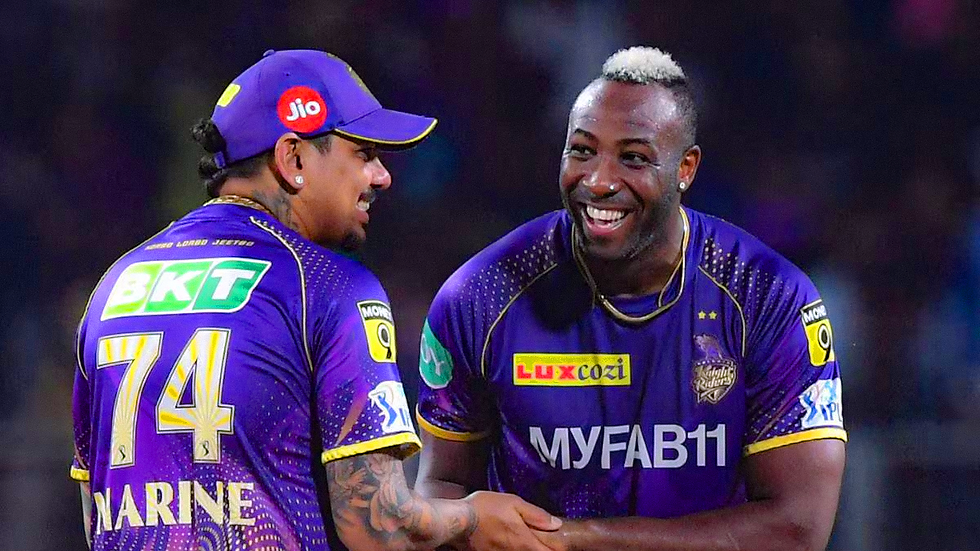
The Trinidadian mystery spinner Sunil Narine, a player who epitomises the Knight Riders brand across the four teams, has been a part of KKR in IPL, LA Knight Riders in Major League Cricket, and Abu Dhabi Knight Riders in ILT20.
The comparison that may ultimately prove most relevant is not City Football Group or Red Bull, but Mumbai Indians. Reliance's cricket operation trading as Indiawin Sports now owns MI New York in MLC, MI Emirates in the ILT20 and MI Cape Town in the SA20, alongside the flagship Mumbai Indians in the IPL. The same model, the same logic. A rival to Knight Riders, both in India and increasingly everywhere else.
What Knight Riders did first was move. They bought into the CPL in 2015, when most IPL owners were still focused entirely on the Indian market. They bought into American cricket in 2020, before the league had played a single match. That willingness to be early to commit to leagues and markets before they had proven themselves commercially is what gives the Group its structural advantage today.
What The Stadium Means
No franchise in cricket history had previously built and owned a stadium outside its home country. The Knight Riders Cricket Ground in Pomona, opened July 1, 2026, changes that.
The $21 million facility is located on a plot of land that covers an expanse of 10 acres which is being leased at the Los Angeles County Fairgrounds Institute. Although it was designed primarily to host home matches of the LA Knight Riders in the MLC, the facility is going to serve a more important role in the future. The ground would act as one of the two cricket venues during the 2028 Los Angeles Olympics during which the sport will be made accessible for the first time since it was last taken off the Olympic roster. In the year 2023, the International Olympic Committee sanctioned cricket games at LA28.
The Knight Riders were already planning the ground before the decision was made.
"Los Angeles is one of the world's most dynamic sports markets," Mysore said at the groundbreaking ceremony in April 2026. "Establishing the Knight Riders Cricket Field in Pomona is a major milestone for our franchise, and we look forward to a long-term partnership to further establish cricket in the USA."

Shah Rukh Khan sent a video message. "Over the years, the Knight Riders have grown into a truly global family," he said, "and every new milestone is special for us."
What neither of them said, but what the stadium represents, is that the Knight Riders Group is no longer treating Los Angeles as a venture. It is treating it as a home.
Mysore has spoken publicly about the 2028 Olympics as a potentially transformational moment for cricket in America, a one-week window where the sport reaches an audience that has never engaged with it, in the city where the world's entertainment industry is based. The Knight Riders are the only franchise with a permanent physical presence in that city when that moment arrives.
That is not an accident.
Nine Trophies. Four Leagues. One Question.
The Knight Riders Group has won nine titles across its franchises: three IPL championships with KKR, five CPL titles with Trinbago, and the inaugural Women's CPL with the Trinbago Knight Riders Women in 2022. LA Knight Riders and Abu Dhabi Knight Riders have yet to add to that count. The LA franchise has not won in three MLC seasons.
In the world of sports, there is more to success than just winning trophies. In the month of February in the year 2008, the Kolkata franchise was bought at the price of $75 million. As per the estimates prepared in the year 2025, the brand value of KKR was calculated to be at $227 million and this value refers only to the IPL. In fact, the brand value of Knight Riders across its four leagues is even higher and it is difficult to calculate the figure precisely. In the year 2024 IPL final was able to attract 169 million viewers on television as compared to the Super bowl which could get only 155 million viewers. Mysore cited this figure at an industry conference in 2025, making the point that cricket's economics have barely scratched the surface of what they could become. "People are talking about billion-dollar valuations," he said. "We have literally just scratched the surface."

He is making a specific argument. The IPL's media rights were sold in 2022 for $6.2 billion over five years. That number, extraordinary in Indian sport, still trails the NFL, the NBA and the Premier League by enormous margins. If cricket finds the global audience that the 2028 Olympics and the expansion of leagues like MLC suggest it might, franchise valuations in every country will move significantly. The owners who hold multiple franchises across multiple markets will benefit disproportionately.
This is the business case for what Knight Riders Group built. Not nostalgia. Not celebrity indulgence. A bet on cricket's global future, placed early, and structured so that wherever that future lands, the franchise is already there.
The Question Cricket Can't Avoid
For most of its history, cricket was organised around nations. The England cricket team played Australia. India played Pakistan. West Indies played Sri Lanka. The international calendar was managed by the ICC and national boards, who controlled which players went where and when.
That model is not broken, but it is being complicated. The auction for the IPL is establishing market values for players in the international cricketing arena better than most national boards ever could with salary caps. T20 leagues such as the IPL, CPL, MLC, ILT20, SA20, Big Bash, and The Hundred offer players constant employment opportunities in a way unimaginable during their grandparents' time. Even though Test cricket is considered prestigious, it has to compete against an unending league calendar in order to attract both players and audiences.
Into this landscape, private ownership groups have introduced a new actor: the global franchise. Not a team representing a city or a nation, but a brand operating across multiple competitions simultaneously, building player pipelines, sharing coaching knowledge, consolidating commercial relationships and making year-round cricket available under a single identity.
Knight Riders Group is the first to have done this systematically in cricket. Mumbai Indians is following the same logic. Others will come.
The question for cricket governance for the ICC, for national boards, for the players' unions still forming around the sport is what happens when private franchise networks become as important to the sport's commercial ecosystem as the nations and boards that have run cricket for a century.
Football did not see that question coming when it arrived. The game reorganised itself around clubs Real Madrid, Manchester United, Barcelona long before anyone thought of multi-club ownership. The clubs became more powerful than many national associations, and the leagues that housed them became the dominant financial and cultural forces in the sport.
Cricket's version of that shift is earlier and slower, because the sport's economics are still smaller and the BCCI's grip over the Indian market is still absolute. But the direction is clear.
On July 1, 2026, in a new cricket ground in Pomona, California, the LA Knight Riders played Washington Freedom. It was a regular league match in a three-year-old American competition. It was also, if you know where to look, the clearest evidence yet that cricket's future will be shaped not only by its national boards and international calendar but by the private franchise networks that are quietly, methodically, and very deliberately making themselves impossible to ignore.
"We have Kolkata Knight Riders in March through May, LA Knight Riders in June and July, Trinbago Knight Riders in August and September, Abu Dhabi Knight Riders in December and January. To look back and see that it's working it validates the thought process." Venky Mysore, CEO, Knight Riders Group


Comments