Why Rote Learning Is Killing Indian Students' Creativity

India’s exam-driven education system rewards memorisation over understanding, producing students skilled at reproducing information but often unprepared for creativity, critical thinking, and ambiguity — the very abilities increasingly demanded by modern universities, workplaces, and innovation-driven economies.
The Education Crisis Nobody Wants to Talk About
Every year, millions of Indian students memorise the process by which photosynthesis occurs, the names of all the Mughal emperors in chronological order, and the exact steps required to solve a differential equation — and then forget nearly all of it within six months of the exam. They graduate from school knowing how to reproduce information under timed conditions and genuinely struggling to ask original questions, challenge assumptions, or connect ideas across domains.
This is not an accident. It is what the system was designed to produce.
How We Got Here
India's mass education system was designed, at independence, to produce a literate, governable population and a supply of graduates for administrative and industrial roles. The examination-as-filter model made sense in this context: with limited university seats and high demand, standardised tests provided a scalable way to allocate them.
The system worked for its purpose. India produced engineers, doctors, scientists, and civil servants at scale. The IITs and IIMs built genuine global reputations. The problem is that the system optimised for one outcome — performance on standardised tests — and the skills required for that outcome and the skills required for a modern economy are becoming increasingly misaligned.
Standardised test performance rewards: memorisation, pattern recognition on familiar problem types, speed over depth, convergent thinking (arriving at the one correct answer), and tolerance for high-stakes performance anxiety. The modern economy increasingly rewards: original problem framing, synthesis across disciplines, comfort with ambiguity, divergent thinking (generating multiple possible approaches), and collaborative communication.
These are not the same skills.
The Neuroscience of Rote Learning
The mechanism matters. When information is memorised through repetition without understanding — which is what most rote learning involves — it is stored in procedural memory, the same neural system used for habitual actions. This memory is accessible when the context closely matches the learning context (an exam that resembles the practice papers) and breaks down when the context changes.
Understanding-based learning, by contrast, encodes information in semantic networks — connected webs of meaning that allow retrieval across diverse contexts. A student who understands why photosynthesis uses carbon dioxide (the relationship between carbon fixation and the Calvin cycle, and how plants build structure) can answer any question about the mechanism, including ones they have never seen. A student who has memorised "photosynthesis uses carbon dioxide to produce glucose and oxygen" can answer questions that match that formulation and struggle with anything else.
Creativity requires semantic network richness — the more densely connected your knowledge, the more novel connections you can generate. Rote learning builds narrow procedural scripts that do not connect to each other. The result is students who can answer exam questions and struggle to think across domains.
What It Actually Looks Like in University and the Workplace
Indian engineering graduates frequently arrive at jobs with strong technical recall — they can reproduce algorithms, circuit diagrams, and thermodynamic formulas — and notable difficulty with unstructured problems. "Given an ambiguous situation, what would you try?" is genuinely harder for many of them than "Here are five possible answers; which is correct?"
This is not a condemnation of intelligence — it is a description of what the educational system trained. The students who overcome this pattern are typically those who found supplementary environments for open-ended thinking: competitive programming (where problems are not template-matched), entrepreneurship clubs, creative projects, or self-directed learning outside the curriculum.
What Young People Can Do About It
The system changes slowly. Your development does not have to wait for the system.
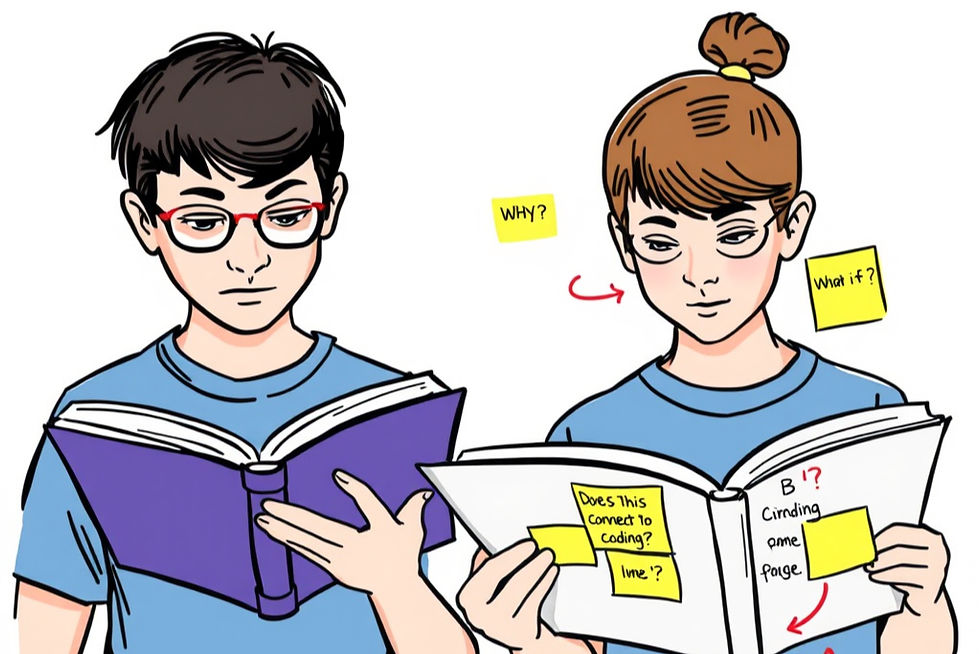
Practise generating questions, not just answers. For any topic you are studying, spend five minutes asking questions the textbook does not answer. Why does this work the way it does? What would happen if one assumption were changed? How does this connect to something in a different field? The act of questioning builds the semantic networks that rote learning does not.
Read widely outside your curriculum. The most creative thinkers — in any domain — tend to draw on knowledge from fields adjacent to their specialisation. Engineers who read history develop different intuitions than engineers who only read engineering. Reading across domains builds the connective tissue between ideas.
Work on open-ended projects. Write an article, build an app, design a product, run a small experiment. Projects with no single correct answer force the cognitive flexibility that exams with correct answers cannot. The discomfort of open-endedness is productive — it is literally building the neural flexibility that rote learning suppresses.
Find peers who argue. The best intellectual development happens in environments where ideas are challenged and defended, not accepted and memorised. A study group that debates the interpretation of economic policy will develop stronger analytical minds than one that divides chapters and reports back.
The Indian education system's emphasis on rote learning is not personal — it did not specifically choose to limit you. But recognising what it did not give you is the first step to getting it yourself.


Comments