Why Are Barcelona Fans Booing Frenkie de Jong? The Real Story

A player with almost 300 appearances for the club was whistled by his own supporters this month, while the new signing beside him got a standing ovation. The story behind that split reaction is messier than it looks.
On August 19, Camp Nou hosted this year's Joan Gamper Trophy. The loudest cheer of the night wasn't for a goal. It was for Rodri, presented to the crowd fresh off his move from Manchester City, the 2026 World Cup winner with Spain, a former Ballon d'Or winner, and the player many fans hope can finally solve a defensive-midfield problem that's followed Barcelona since Sergio Busquets left in 2023. Minutes later, the stadium announcer read out Frenkie de Jong's name. Part of the crowd whistled.
De Jong kept walking toward his teammates. He didn't react.

He has made 293 appearances for Barcelona, more than any other Dutch player in the club's history, more than Ronald Koeman, more than Patrick Kluivert. He has three La Liga titles, two Copa del Reys and three Spanish Super Cups. By most reasonable measures, he's one of the more accomplished footballers to wear
the shirt this decade.
Frenkie de Jong's Strengths and Weaknesses

Start with what De Jong does on a pitch, because it's easy to describe and surprisingly hard to appreciate watching casually.
His specialty is receiving the ball in tight spaces, under pressure, with a defender closing him down, and not losing it. Data trackers have repeatedly rated his press resistance among the best of any midfielder in Europe; one recent breakdown of Barcelona's current squad placed him above even Pedri on that specific measure. What he does next matters more.
Rather than release the ball immediately, De Jong tends to hold it a beat longer than most midfielders would risk, then drives forward with it himself. Across recent seasons he's ranked among Europe's leaders for progressive carries: advancing the ball real distance up the pitch, not just shuffling it sideways.
That combination is rarer than it sounds, which is why he's been used almost everywhere auxiliary centre-back, the deep man in a double pivot, a box-to-box eight. His passing backs it up: over 90 percent completion in most Barcelona seasons, a number usually reserved for far more conservative players. He plays a similar role for the Netherlands, where he's won more than 60 caps.
The gaps are real too. De Jong isn't a natural tackler, and his defensive numbers, duels and ball-winning actions specifically, have long lagged behind the rest of his profile. Manchester United's scouts flagged the same issue back in 2022: he needs a more combative body playing next to him. Left alone as a lone holding midfielder, he can be exposed when possession turns over.
What Went Wrong After Barcelona Signed De Jong?
None of this is a secret inside Barcelona. It's largely why they signed him.
De Jong arrived from Ajax in 2019, aged 21, off a season that took Ajax to the Champions League semi-finals, beating Real Madrid and Juventus along the way, and delivered a domestic double at home. Barcelona paid an initial €75 million, rising to around €86 million with add-ons, beating Manchester City and Paris Saint-Germain to his signature. It wasn't just a transfer fee. It was a statement that Barcelona had signed a future superstar, not merely a very good 21-year-old.
De Jong himself has admitted the gap between that billing and his first season. "I was just an ordinary player," he told Voetbal International in 2021, midway through a far better second campaign that finally delivered seven goals, seven assists, and his first trophy, under Ronald Koeman.
Injuries, Position and the Wage Controversy
If that 2020/21 season suggested De Jong could become Barcelona's best player, everything since has suggested a career shaped as much by circumstance as by form.
Start with position. Across five permanent coaches, Ernesto Valverde, Quique Setién, Koeman, Xavi Hernández and now Hansi Flick, De Jong has rarely kept one settled job for long: a double pivot, a lone six, an attacking "interior," occasionally centre-back. Xavi openly preferred him further forward even as fans wanted him pushed into the deepest role. A player asked to be several different things over seven years is hard to judge by one standard, and his modest goal and assist numbers, a personal-best eight assists last season aside, haven't helped supporters see the value in what he does elsewhere.
Then injuries. De Jong has missed more than 400 days at Barcelona through fitness problems, including three separate right ankle injuries in the 2023/24 season alone, the last of them in that April's Clásico, ending his campaign and costing him Euro 2024. A hamstring injury wiped out the final 11 games of 2025/26. This summer he returned from the World Cup having played through knee pain for four matches; Barcelona later confirmed a torn medial collateral ligament that will keep him out for months.
Then money. Barcelona's financial crisis in the early 2020s made De Jong's salary, reportedly close to €20 million a year at its peak and backloaded from a pandemic-era pay deferral, a matter of public argument. In 2022, Barcelona agreed a fee with Manchester United, only for the move to collapse in a dispute over roughly €17 million in wages the club owed him.
He stayed, but the reputation that followed, reluctant to take a pay cut, expensive for his output, was hard to shake, even after president Joan Laporta later said the club turned down a €100 million bid because De Jong was too important to sell. His new contract through 2029, signed last October, came with a reported pay cut, bringing his wages closer to what Pedri and Raphinha earn.
Why Frenkie de Jong Was Never a Busquets Replacement
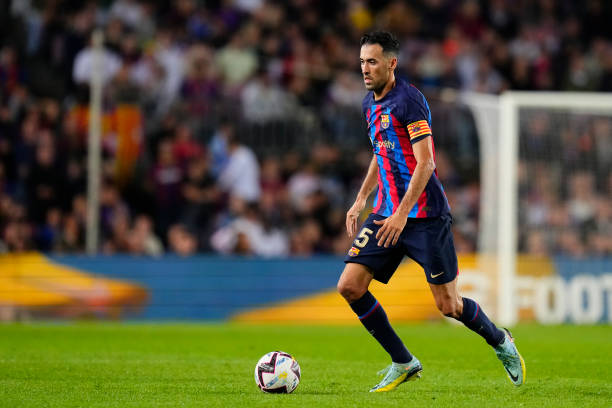
Underneath a lot of this sits one specific misunderstanding: that De Jong was bought to replace Busquets.
He was never suited to it, and that isn't really his fault. Busquets's genius was almost entirely defensive and positional: reading danger before it happened, rarely sprinting anywhere, built to stand in one small patch of grass and run a game through where he stood rather than what he did with the ball.
De Jong is a carrier, built to cover ground and beat pressure with his feet, not to screen a back four from a standing start. Asking him to be a straight Busquets replacement was asking him to do a different job. Xavi tried it during Busquets's final season with decent results, but Barcelona kept searching for a true long-term successor for two more years after Busquets actually left, right up until this summer.

How Rodri's Arrival Changes the De Jong Debate
That search ended when Barcelona signed Rodri from Manchester City in a deal worth up to around €75 million, including add-ons. The timing wasn't a coincidence: by several accounts, De Jong's knee injury was one of the reasons Flick went shopping for midfield cover in the first place. Rodri now looks likely to take De Jong's spot next to Pedri, possibly even once De Jong is fit again. Add Gavi, Marc Casadó, Marc Bernal, Dani Olmo and Fermín López to that group, and Barcelona have roughly eight senior midfielders for two or three starting places. For the first time in his career at the club, De Jong isn't just fighting his body. He's fighting a queue.
He has pushed back hard against the darker version of this story. After his injury became public, De Jong used Barça's own media to deny reports, largely from journalist Gerard Romero, that he had refused to play in last season's Champions League exit to Atlético Madrid, and that his relationship with Flick had broken down. "That is not true," he said. "It is simply not correct." Flick backed him publicly days later, calling their relationship excellent. Yet on August 21, reports emerged that De Jong had lost his place in Barcelona's captaincy group, adding another layer to the uncertainty surrounding his role.
Why Are Some Barcelona Fans Still Frustrated With De Jong?
None of this fully explains a section of Camp Nou whistling at a player with 293 appearances for the club. Most Barcelona supporters didn't boo him that night; plenty were visibly annoyed that anyone did. The discomfort around De Jong was never really about whether he can play. Judged purely as a footballer, he clearly can.
It's about seven years of a fanbase being told, in one way or another, that they were getting the heir to Cruyff, the long-term Busquets solution, a €75 million superstar, and getting instead a very good, frequently injured, positionally restless midfielder who is not quite any of those things. De Jong isn't failing Barcelona. Barcelona may simply have spent seven years waiting for someone he was never going to become.


Comments