The Brand That Made Sure It Couldn't Lose

In theory, Sunday's World Cup final will pit Argentina against Spain. Dig deeper, and you'll see the two teams are wearing the same three stripes.
Even before the referee blows the whistle on match day, Adidas has already won.
For the first time in the history of the World Cup, the two competing nations are outfitted in gear from the same sportswear manufacturer. No matter whether Messi wins or Lamine Yamal does, Adidas will come out of MetLife Stadium as the outfitter of the world champion. This is not an accident. It is the result of years of carefully planned, expensive and extremely strategic positioning within the sport.

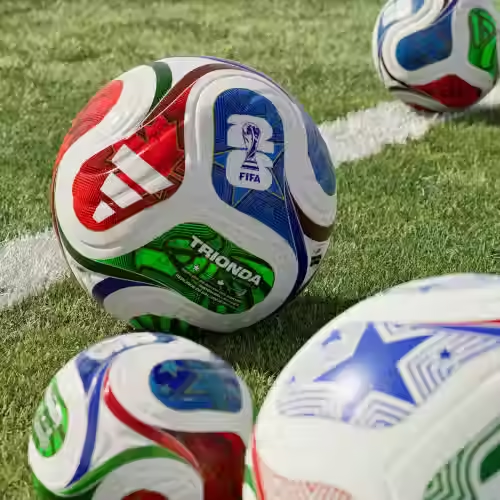
The German company has been supplying the official World Cup match ball since the 1970 World Cup in Mexico. In 56 years of the competition, each and every ball kicked at the World Cup has carried the Adidas name. For the current World Cup, the brand unveiled its latest match ball, called Trionda – a word made up of tri (three) and onda (wave) in tribute to the three countries which are hosting this year's edition of the World Cup. For the semi-finals and the final, the brand launched the Trionda Final – a ball decorated in gold and black colours after the shape of the World Cup trophy and featuring Connected Ball Technology that can collect real-time data and send it to match officials for better VAR and offside decisions.
The ball is not only an Adidas product. It is also Adidas' technology, deeply embedded in the World Cup action.
And then there are the players.
"From the jerseys on the players' backs, to the boots on their feet, to the ball rolling on the grass, the 2026 World Cup Final is Adidas from start to finish."

The company has recently launched its "LA FINAL" campaign – a movie poster-style advertisement featuring stars of both sides of the World Cup final: Messi, Rodrigo De Paul, Alexis Mac Allister, Julián Álvarez from the Argentinean side and Lamine Yamal, Pau Cubarsí, Pedri and Dani Olmo from Spain. Eight of the most followed footballers in the world, from both sides of the final, are wearing the kit produced by Adidas.
Adidas did not arrange the final between these two teams. But it positioned itself in such a way that whoever reaches the World Cup final will inevitably be a part of its narrative.
Across the two teams, Adidas sponsors 23 players: 12 from Spain and 11 from Argentina. So every shot at goal, defensive clearance, tackle, dribble, save you get the picture. There is the Adidas logo on the boots, the shirt of the player, and sometimes on both.
Nike, for its part, will not be present in New Jersey this Sunday. The American company made a big splash with its high-profile entry into the World Cup campaign through a poster-like ad featuring stars Mbappé and Haaland, who are both playing for Nike. Both France of Mbappé and Norway of Haaland are Nike sponsored teams.
Both were eliminated at the World Cup before reaching the final. An Adidas' spokeswoman said in a statement this week that the company is "proud" to sponsor both finalists. But even Nike will go home with some prizes: Germany's kit rights, although the country was eliminated from the World Cup in Round of 32. It is not much of a consolation.
This is not new territory for Adidas. In the last 10 World Cups, Adidas outfitted five champions: West Germany in 1990, France in 1998, Spain in 2010, Germany in 2014, and Argentina in 2022. Adidas established its football identity on the biggest international trophy in the sport by meticulously signing national federations on multi-year contracts, securing the ball sponsorship agreement with FIFA and identifying young talents early enough for them to be wearing three stripes by the time they became stars.

Lamine Yamal is the perfect example. The Spanish player is 18 and already the protagonist of the most prominent World Cup campaign of Adidas. His face was on the launch event of the Trionda Final, next to Messi. Two Adidas-sponsored athletes, two generations, the same tournament and the same final.
The business of the World Cup final is rarely just about what is going on on the pitch. Estimated global television audience of more than one billion viewers makes this Sunday's match the biggest advertising window in sports. Each close-up of a player's boot, each kit shot in slow motion, each post-goal celebration – everything is an advertisement of the brand that made the shirt.
This year, on both sides of the pitch, that is Adidas.
One team will raise the trophy. Both team captains will wear the same badge. And somewhere in the Adidas headquarter in Herzogenaurach, Germany, the result of this game will be of secondary importance compared to the fact that it is happening.


Comments