The Rise of Hinglish: Why India's Language Isn't Confused, It's Evolving

Hinglish is not broken Hindi or imperfect English — it is a dynamic language shaped by modern Indian life, internet culture, urban communication, and bilingual identity. Far from weakening language, code-switching reflects cultural adaptability, emotional nuance, and the natural evolution of how millions of Indians actually speak today.
Code-Switching as a Cultural Superpower
"Yaar, I was literally so done with that meeting, pura waste of time tha." If you understood that sentence completely, and found nothing jarring about it, you are a native Hinglish speaker — one of hundreds of millions of people who move fluidly between Hindi and English within single sentences, conversations, and thoughts, without registering the transition as a transition at all.
This fluidity is often described by language purists as corruption — a dilution of both Hindi's literary heritage and English's grammatical integrity. This description is both technically incorrect and culturally condescending. Hinglish is not failed Hindi or failed English. It is a third thing — a living, evolving, expressive language that does things neither Hindi nor English does alone.
What Code-Switching Actually Is
Code-switching — the practice of moving between two or more languages within a single conversation — is not a sign of incomplete mastery of either language. Linguists have established consistently that code-switching is a sophisticated communicative behaviour that requires full competence in both languages simultaneously. [Likely]
People do not code-switch because they cannot think of the word in one language. They code-switch because the other language offers something — a nuance, a register, an emotional colour, a cultural reference — that is not available in the same way in the first language.
"That was so cringe" in Hinglish carries a specific cultural weight that "woh bahut sharmindagi wala tha" does not quite capture — not because English is superior, but because "cringe" in this usage has a specific contemporary social meaning that arrived with the internet and has not yet been mapped onto a Hindi equivalent with the same resonance.
Why Hinglish Works the Way It Does
Hinglish is not random. There are patterns. English nouns replace Hindi nouns for modern concepts — office, laptop, meeting, traffic — that entered Indian life through English-language institutions. Hindi verbs and connectors often remain — "kar lena," "tha," "hai," "yaar" — because they carry emotional and grammatical functions that English prepositions and conjunctions do not replicate with the same warmth.
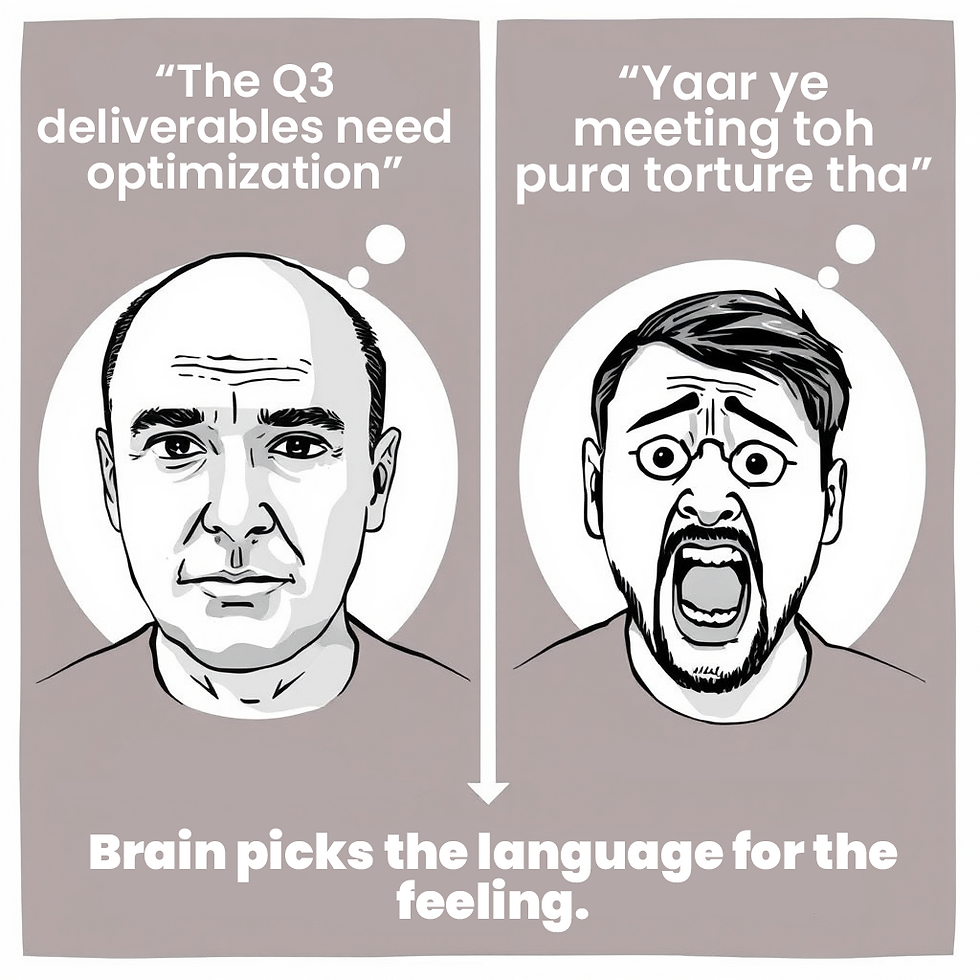
The emotional register shifts too. Technical, professional, and neutral discussion tends toward more English; emotionally loaded conversation — affection, frustration, humour, intimacy — tends toward more Hindi or regional language. This is not arbitrary. Different languages carry different emotional histories for their speakers, and the brain naturally reaches for the one whose emotional register fits the moment.
Hinglish in Media and Commerce
The advertising industry understood this before linguists finished arguing about it. By the 2000s, major Indian brands were writing campaigns in Hinglish — not because they were lazy, but because Hinglish was where their audience actually lived. "Kya aap closeup karte ho?" is a sentence that works precisely because of its mixture.
Bollywood has always been Hinglish to various degrees — the cinematic dialogue of films set in urban India has used English-Hindi mixing since the 1970s. What has changed is the degree of mixing and its acceptance as normal. Contemporary Bollywood dialogue, especially in films aimed at young urban audiences, is often indistinguishable from the way those audiences actually speak.
Social media has accelerated this considerably. Meme culture on Indian Instagram and Twitter operates almost entirely in Hinglish — the combination is native to the medium because the medium's users are native to the combination. Attempts to be funny in pure Hindi or pure English on platforms where the audience is Hinglish-speaking often fall flat not because of content quality but because the register is wrong.
The Regional Layer
Hinglish is the national version of a phenomenon that exists regionally everywhere in India. Tanglish (Tamil-English) in Tamil Nadu. Kanglish (Kannada-English) in Karnataka. Benglish in Bengal. Marathi-English in Maharashtra. Each is a distinct linguistic system with its own vocabulary, grammar, and cultural identity.
These regional code-switches are not subordinate to or less sophisticated than Hinglish — they are independent linguistic evolutions shaped by the specific histories of their constituent languages.
The Purist's Objection and Why It Misses the Point
The objection that Hinglish corrupts Hindi conflates two different concerns: the health of Hindi as a literary and formal language (a legitimate concern about institutional support and curriculum) and the communicative choices of everyday speakers (not the purist's call to make).
Languages have always evolved through contact. Sanskrit influenced Dravidian languages; Persian shaped Urdu and Hindi; Portuguese left words in Konkani and Marathi; English arrived through colonialism and stayed through utility. Every language currently spoken in India is the result of centuries of exactly this kind of mixing, influence, and evolution.
Hinglish is not the end of Hindi. It is what Hindi does when it meets the world its speakers are actually living in. That has always been what living languages do.


Comments