Prime Minister Shehbaz Sharif said the U.S. and Iran have agreed on a peace deal text, boosting hopes of a diplomatic breakthrough in the region.

No immediate comment was forthcoming from either the White House or Iranian officials following Mr. Shehbaz’s claim.
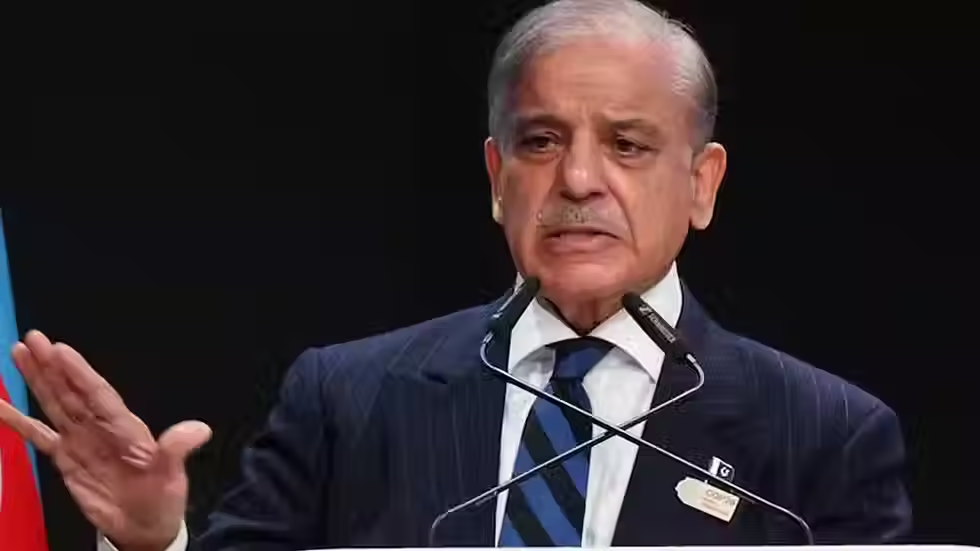
Shehbaz Sharif Says Agreement Has Reached Final Draft Stage
Pakistan Prime Minister Shehbaz Sharif has announced that the United States and Iran have agreed on the text of a proposed peace deal, raising expectations of a major diplomatic breakthrough in West Asia.
In a social media post on Friday (June 13, 2026), Shehbaz Sharif said that despite what he described as a sustained misinformation campaign aimed at undermining negotiations, significant progress had been achieved through Pakistan’s mediation efforts.
“Amid ongoing intensive mediation efforts by Pakistan, we are fully aware of the misinformation being spread by those seeking to derail the peace process,” he stated.
According to the Pakistani Prime Minister, both sides have now reached a final agreed draft of the peace agreement, with Pakistan working closely with all parties involved to determine the next phase of implementation.
He added that the prospect of peace in the region has rarely appeared as close as it does now.
Pakistani PM Tags Trump, Vance and Iranian Leadership
In his post, Shehbaz Sharif tagged several key leaders connected to the negotiations, including U.S. President Donald Trump, Vice President J.D. Vance, Secretary of State Marco Rubio, Iranian President Masoud Pezeshkian, and Iranian Foreign Minister Abbas Araghchi.
The statement came amid growing speculation and media reports regarding a possible agreement between Washington and Tehran.
However, neither the White House nor Iranian authorities immediately responded to Sharif’s assertion that the peace deal text had already been finalized.
Iran Signals Progress but Urges Caution
Earlier, Iranian Foreign Minister Abbas Araghchi also indicated that negotiations were advancing, suggesting that the proposed Islamabad Memorandum of Understanding was closer than ever to completion.
In a social media statement, Araghchi urged media organizations and commentators to avoid speculation about the contents of the agreement until negotiations are officially concluded.
He emphasized that details of the proposed arrangement would be made public at the appropriate time and in line with Iran’s commitment to transparency.
Notably, President Donald Trump shared Araghchi’s statement on his own social media platform, though he did not provide additional information about the status of the talks.
J.D. Vance Rejects Rumours Surrounding Proposed Deal
Meanwhile, U.S. Vice President J.D. Vance pushed back against reports circulating online about the proposed agreement, particularly claims related to reopening the Strait of Hormuz and ending Iran’s nuclear weapons programme.
Vance said there was a considerable amount of inaccurate information being shared regarding the negotiations.
He clarified that Iran would not receive direct cash payments and that no funds would be released simply for signing an agreement or participating in diplomatic meetings.
According to Vance, any economic benefits for Iran would depend on the country's compliance with its commitments under the proposed framework.
U.S. Says Agreement Could Transform the Region
J.D. Vance described the emerging arrangement as one that could significantly reshape the region and contribute to long-term stability and peace.
At the same time, he advised the public to be cautious about relying on anonymous social media accounts and unverified media reports for information regarding the negotiations.
“The President is going to get us a good outcome, one way or the other,” Vance said, expressing confidence in Donald Trump’s handling of the talks.
As of now, officials have not released the contents of the proposed agreement, but statements from Pakistan, Iran, and senior U.S. leaders suggest that negotiations may be approaching a decisive stage.


Comments